Dissertation timelines tighten the moment data collection ends. Many students reach this stage with completed surveys but no clear path to analysis. SPSS opens, outputs appear, yet nothing feels certain. That is where projects stall.
Most delays come from incorrect analysis, not lack of effort. Students choose the wrong tests, skip assumptions, or misinterpret outputs. Supervisors return Chapter 4 with corrections, forcing a full rewrite.
If you need help with SPSS, the priority is not running tests. You need results that align with your research model and pass academic review on first submission.
Why SPSS Becomes a Problem at Dissertation Level
SPSS executes commands. It does not guide decisions.
That gap leads to:
- Wrong statistical test selection
- Poor handling of Likert scale data
- Ignoring assumptions like normality and multicollinearity
- Copying outputs without interpretation
- Submitting results that fail APA standards
For example, many students run correlation or regression without checking assumptions. This leads to invalid conclusions even when outputs look complete. A proper approach to checks like normality, as explained in this normality test guide, prevents that issue early.
The Real Reason Students Search for Help With SPSS Analysis
Most students do not struggle with SPSS buttons. They struggle with decisions.
You need to:
- Match tests to hypotheses
- Interpret output correctly
- Connect findings to your research objectives
- Write results in a structured academic format
Likert-scale data creates one of the biggest problems. Many dissertations get flagged because of incorrect treatment of ordinal data. If your study relies on survey responses, structured support such as Likert scale analysis help ensures your analysis remains valid and defensible.
For a deeper breakdown of how survey data flows into analysis, this survey data analysis guide also clarifies the process.
What Your Dissertation Actually Requires From SPSS
Your analysis must do three things:
- Match your research questions
- Apply the correct statistical methods
- Present results clearly in APA format
Typical mappings include:
- Relationships → correlation (bivariate correlation in SPSS)
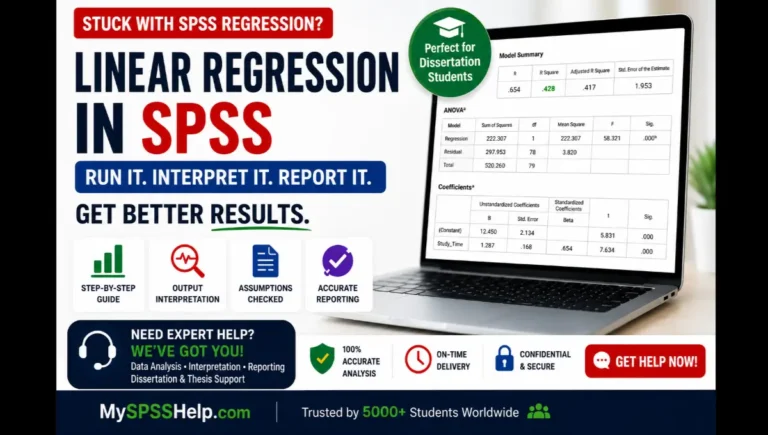
- Prediction → regression (multiple regression in SPSS)
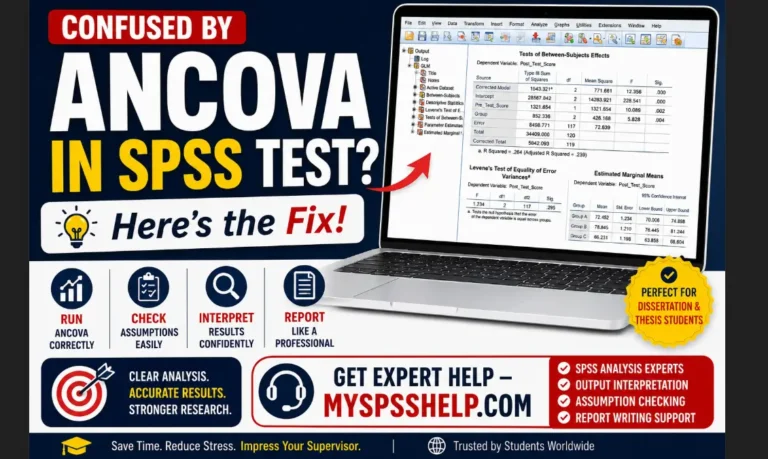
- Group comparisons → t-tests (independent samples t-test) or ANOVA (one-way ANOVA guide)
If this alignment fails, your results will not hold during supervisor review.
Students who search for help with SPSS statistics often already ran tests but cannot justify them.
Where Most Dissertation Projects Break Down
Across SPSS-based dissertations, the same issues appear:
- Wrong test selection
- Poor data cleaning
- Ignoring assumptions
- Weak interpretation
- Rejected Chapter 4 drafts
Data preparation alone causes many of these issues. If your dataset is not structured properly, every test that follows becomes unreliable. A structured workflow like this data cleaning in SPSS guide shows how to fix that before analysis begins.
You also need to ensure reliability before testing relationships. Many supervisors expect checks such as Cronbach’s alpha, which is covered clearly in this reliability analysis guide.
How to Handle SPSS the Right Way
A proper SPSS workflow follows a structured sequence:
Define Variables and Hypotheses
Know exactly what you are testing.
Prepare Your Data
Clean, label, and structure your dataset correctly.
Choose the Right Tests
Each test must directly answer a research question.
Validate Assumptions
Check normality, variance, and model conditions.
Interpret Results
Focus on significance, relationships, and model strength.
Report in APA Format
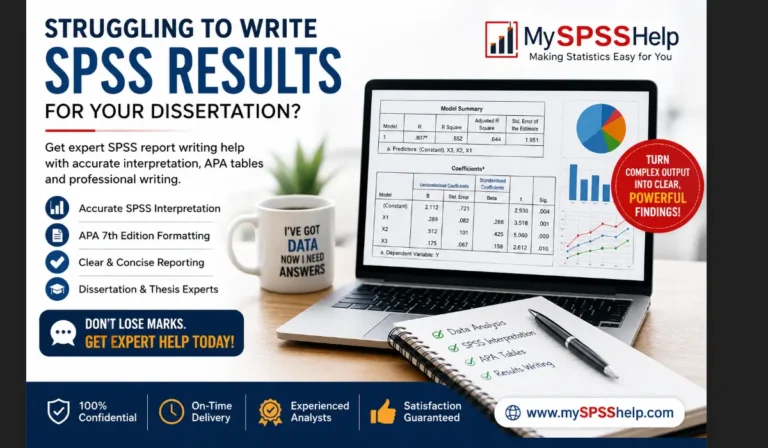
Translate outputs into structured academic writing. If you struggle here, this SPSS dissertation write-up guide shows how results should appear.
Skipping any of these steps leads to revisions.
Why Students Still Need Help With SPSS Assignment Work
Even with guides, SPSS becomes technical at dissertation level.
You are expected to:
- Justify every statistical decision
- Interpret outputs correctly
- Align findings with your research framework
- Respond to supervisor feedback
This is where most students lose time.
When results start feeling unclear, it usually means something is off in the process. Common issues like missing outputs or errors are covered in resources such as this SPSS output troubleshooting guide.
What You Get When You Work With Experts
Instead of trial and error, you get structured, submission-ready results.
A proper SPSS support process includes:
- Correct test selection
- Clean SPSS outputs
- Full assumption testing
- Clear interpretation
- APA-formatted Chapter 4
- Revisions based on supervisor feedback
If you want full support handled end-to-end, the approach outlined in dissertation data analysis services shows how your entire results section can be completed professionally.
For smaller tasks like coursework or urgent deadlines, students often rely on focused support such as help with SPSS assignment.
When You Should Get Help With SPSS
You should not wait if:
- Your supervisor already requested revisions
- You are unsure which test to use
- Your results do not align with your hypotheses
- You are close to submission
Delays at this stage usually lead to rushed corrections and weak results.
Working with a structured service like online SPSS help ensures your analysis moves forward without repeated setbacks.
Conclusion
SPSS determines whether your dissertation progresses or gets sent back for revisions. The difference lies in structure, accuracy, and interpretation.
You need more than outputs. You need analysis that:
- Matches your research design
- Passes supervisor review
- Meets academic standards
If your current results feel uncertain, that usually means something is off. Getting the right help with SPSS at this stage can move your dissertation from stalled to complete without repeated corrections.
FAQs on Help with SPSS for Dissertation Students
1. Can I get help with SPSS for my dissertation online?
Yes. Many students work with experts remotely for full analysis and Chapter 4 writing.
2. How long does SPSS analysis take?
Most projects take 2–4 days depending on complexity.
3. What if my SPSS results were rejected?
You need to review test selection, assumptions, and interpretation.
4. Can someone help with SPSS statistics and interpretation?
Yes. Interpretation forms a key part of dissertation analysis.
5. What are common SPSS mistakes?
Wrong tests, poor data preparation, and weak reporting.
6. Can SPSS analyze Likert scale data?
Yes, but it must be handled correctly to avoid invalid results.
7. Do I need SPSS knowledge if I get help?
You should understand the basics for your defense.
8. What statistical tests are common in dissertations?
Correlation, regression, ANOVA, and chi-square.
9. Can I get urgent help with SPSS assignment?
Yes, urgent projects can be handled quickly.
10. Why does SPSS output confuse students?
Because outputs require interpretation, not just reading tables.
11. How do I write SPSS results in APA format?
Extract key values and present them in structured sentences.
12. Can SPSS results be incorrect?
Yes, if assumptions are ignored or wrong tests are used.
13. How do I know which test to use?
It depends on your variables and research questions.
14. Is professional SPSS help worth it?
It saves time, reduces revisions, and improves result quality.
15. What if I am close to submission?
Getting structured support helps you finish without delays.