Many dissertation students run regression analysis in SPSS expecting a straightforward process, only to encounter confusing problems related to assumptions, residual plots, and inconsistent variance. One of the most misunderstood regression issues is heteroscedasticity.
Students often discover this problem after receiving feedback from supervisors such as:
- “Your regression assumptions were violated.”
- “Check for heteroscedasticity.”
- “Your standard errors may be biased.”
- “Your model may not be reliable.”
For students already stressed by deadlines, Chapter 4 writing, or statistical interpretation, this can become overwhelming very quickly.
At My SPSS Help, we regularly help dissertation students identify, test, interpret, and correct heteroscedasticity problems in SPSS regression analysis. Whether you are struggling with residual plots, Breusch-Pagan tests, regression assumptions, or output interpretation, expert guidance can save significant time and reduce academic stress.
What Is Heteroscedasticity?
Heteroscedasticity occurs when the variance of residuals or errors in a regression model is not constant across all levels of the independent variable.
In simple terms, the spread of prediction errors changes as the values of the predictor variable increase or decrease.
In regression analysis, one important assumption is homoscedasticity, which means the residuals should have constant variance.
When this assumption is violated, heteroscedasticity occurs.
Students performing regression analysis in SPSS frequently encounter this issue when analyzing:
- Survey data
- Economic data
- Healthcare datasets
- Behavioral research
- Cross-sectional studies
- Questionnaire responses
If you are new to regression analysis, our guide on multiple regression in SPSS can help you understand the foundation before testing assumptions.
Why Is Heteroscedasticity a Problem?
Heteroscedasticity becomes a serious problem because it affects the reliability of regression results.
Although the regression coefficients themselves may remain unbiased, the standard errors become distorted. This leads to inaccurate hypothesis testing and unreliable statistical conclusions.
Incorrect Standard Errors
One major issue is that standard errors become either underestimated or overestimated.
When this happens:
- P-values become unreliable
- Confidence intervals become inaccurate
- Hypothesis tests become misleading
- Statistical significance may be false
This can cause dissertation students to report incorrect findings in Chapter 4 or discussion sections.
Students already confused by significance levels can also review our guides on:
Reduced Model Reliability
Heteroscedasticity weakens the reliability of regression models.
A model with heteroscedasticity may appear statistically significant while actually producing unstable predictions.
This becomes especially dangerous in dissertation research where students must defend the validity of their analysis.
Poor Dissertation Feedback
Many supervisors specifically check regression assumptions before approving dissertation findings.
If heteroscedasticity exists and is not addressed:
- Examiners may reject the analysis
- Supervisors may request re-analysis
- Results sections may require major corrections
- Dissertation submission may be delayed
Students facing these issues often seek professional dissertation statistics help to avoid costly mistakes.
Heteroscedasticity in Regression Analysis
Heteroscedasticity commonly appears in regression models where variability changes across observations.
For example:
- Income data often shows greater variability at higher income levels
- Survey responses may vary more among certain demographic groups
- Clinical trial outcomes may produce unequal variance across treatment groups
In SPSS regression output, heteroscedasticity is typically diagnosed using:
- Residual scatterplots
- Statistical tests
- Residual analysis
- Standardized residual patterns
Students conducting regression analysis can also benefit from our tutorials on:
- how to run a linear regression in SPSS
- simple linear regression in SPSS
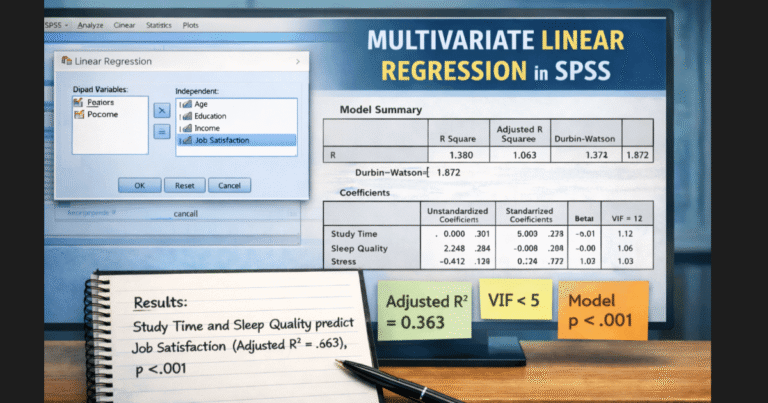
- multivariate linear regression SPSS guide
Homoscedasticity vs Heteroscedasticity
Understanding the difference between homoscedasticity and heteroscedasticity is essential for dissertation students.
Homoscedasticity
Homoscedasticity means residuals maintain equal variance across all predictor values.
Characteristics include:
- Stable error variance
- Reliable standard errors
- Accurate p-values
- Valid regression assumptions
In residual plots, the data points appear evenly spread.
Heteroscedasticity
Heteroscedasticity means residual variance changes across predictor values.
Characteristics include:
- Unequal error variance
- Distorted standard errors
- Misleading significance tests
- Violated regression assumptions
Residual plots often display funnel-shaped or cone-shaped patterns.
Students struggling with assumption testing in SPSS frequently seek help through our online SPSS help services.
Causes of Heteroscedasticity
Several factors can cause heteroscedasticity in dissertation data.
Poor Data Quality
Errors during data entry, coding mistakes, or missing values often create unstable residual patterns.
Students working with questionnaire data should first ensure proper dataset preparation using our guides on:
Outliers
Extreme observations frequently produce unequal variance.
Outliers can significantly distort regression results and increase residual spread.
Incorrect Model Specification
Leaving out important variables or using the wrong regression model can create heteroscedasticity problems.
Non-Normal Data
Highly skewed variables often contribute to unstable residual patterns.
Students should also test assumptions such as normality before running regression analysis.
Our guide on normality test in SPSS explains how to assess data distribution properly.
Large Differences in Predictor Values
When predictor values vary widely across observations, variance instability becomes more likely.
How to Check Heteroscedasticity in SPSS
Many students panic because SPSS does not provide a direct “heteroscedasticity button.” However, SPSS offers several methods for diagnosing the problem.
Residual Scatterplots
One of the most common methods involves plotting standardized residuals against standardized predicted values.
In SPSS:
- Run regression analysis
- Save standardized residuals and predicted values
- Create a scatterplot
- Examine the residual pattern
A random spread suggests homoscedasticity.
A funnel or cone shape suggests heteroscedasticity.
Students unfamiliar with SPSS plotting procedures can seek assistance through our SPSS data analysis services.
Breusch-Pagan Test for Heteroscedasticity
The Breusch-Pagan test is one of the most recognized statistical tests for detecting heteroscedasticity.
The test examines whether residual variance depends on independent variables.
Although SPSS does not directly include the Breusch-Pagan test in standard menus, it can still be conducted through syntax, extensions, or external statistical software.
Researchers can also learn more about regression assumptions through official resources such as:
Glejser Test
Another method involves regressing absolute residuals on predictor variables.
Significant relationships may indicate heteroscedasticity.
How to Overcome Heteroscedasticity
Many dissertation students assume they must abandon their analysis once heteroscedasticity appears. Fortunately, several solutions exist.
Transform Variables
Log transformations or square root transformations can stabilize variance.
This is especially common with income, expenditure, and clinical data.
Remove Outliers Carefully
Extreme values may distort residual variance.
However, students should only remove outliers when academically justified.
Use Robust Standard Errors
Robust standard errors adjust for unequal variance and improve reliability.
Improve Model Specification
Including omitted variables often reduces heteroscedasticity.
Increase Sample Size
Small samples sometimes exaggerate variance instability.
Students calculating appropriate sample sizes can also review:
Common SPSS Mistakes Students Make
Many dissertation students unintentionally create heteroscedasticity problems through avoidable SPSS mistakes.
Common errors include:
- Using the wrong regression model
- Ignoring assumption tests
- Misinterpreting residual plots
- Failing to clean data
- Including severe outliers
- Reporting results without diagnostics
Our common SPSS errors guide explains many of these problems in detail. Also check out our guide on SPSS Shortcuts.
Why Dissertation Students Seek Help With Heteroscedasticity
Heteroscedasticity is one of the most frustrating regression issues because many students understand how to run SPSS procedures but do not understand the statistical assumptions behind them.
Students often seek professional help because they need:
- Accurate regression analysis
- Assumption testing support
- Output interpretation
- Chapter 4 reporting assistance
- Supervisor-ready results
- Fast corrections before deadlines
At My SPSS Help, we help dissertation students diagnose and correct heteroscedasticity problems in SPSS, R, and other statistical software.
Whether you need help with regression assumptions, SPSS outputs, or dissertation reporting, our experts provide practical academic support tailored to your research project.
Final Thoughts on Why is heteroscedasticity a problem
Understanding heteroscedasticity is essential for producing valid and reliable regression results in dissertation research.
Ignoring unequal variance can lead to inaccurate p-values, unreliable conclusions, and rejected dissertation findings. Fortunately, students can identify and correct heteroscedasticity using proper diagnostic methods and statistical solutions.
If you are struggling with regression assumptions, SPSS outputs, or dissertation analysis, professional guidance can help you complete your work more confidently and avoid costly academic mistakes.
At My SPSS Help, we support students with SPSS regression analysis, heteroscedasticity testing, dissertation statistics, data interpretation, and APA reporting.
Frequently Asked Questions on Why is heteroscedasticity a problem
What is heteroscedasticity in regression?
Heteroscedasticity occurs when residual variance changes across different levels of predictor variables in a regression model.
Why is heteroscedasticity a problem?
It causes unreliable standard errors, misleading p-values, and invalid hypothesis testing results.
How do I check heteroscedasticity in SPSS?
Students commonly use residual scatterplots, residual analysis, and statistical tests such as the Breusch-Pagan test.
What causes heteroscedasticity?
Common causes include outliers, poor data quality, incorrect model specification, skewed data, and unequal predictor variability.
What is the difference between homoscedasticity and heteroscedasticity?
Homoscedasticity means equal residual variance, while heteroscedasticity means unequal residual variance.
Can heteroscedasticity affect dissertation results?
Yes. It can invalidate regression findings and lead to incorrect conclusions.
Can SPSS detect heteroscedasticity?
Yes. SPSS can help students identify heteroscedasticity using residual plots and regression diagnostics.
How do you overcome heteroscedasticity?
Common solutions include transforming variables, removing outliers, improving model specification, and using robust standard errors.
Is heteroscedasticity common in survey research?
Yes. Survey and cross-sectional data frequently produce heteroscedasticity problems.
Can you help me fix heteroscedasticity in my dissertation?
Yes. Our experts assist students with regression analysis, SPSS diagnostics, heteroscedasticity correction, and dissertation reporting.