Many students run a multiple linear regression in SPSS, get the output, and immediately realize something is wrong. The model is not significant, coefficients do not align with expectations, or the supervisor flags serious issues in interpretation. This is where most research projects stall.
The problem is rarely the software. In most cases, the issue starts earlier, often during data entry, cleaning, or variable setup. If your dataset contains inconsistencies, missing values, or coding errors, your regression results will never be reliable. Before attempting any fixes, ensure your dataset has been structured correctly using proper SPSS data entry procedures and cleaned thoroughly through a structured data cleaning process in SPSS.
Why Your Multiple Regression Results in SPSS Are Not Working
When regression results look wrong, the issue usually falls into a few clear categories. Most students encounter these problems without realizing they are happening.
One of the most common issues is incorrect variable setup. Independent variables may be poorly coded, or categorical variables may be entered without proper dummy coding. This leads to misleading coefficients and invalid conclusions.
Another frequent problem is hidden errors in the dataset. These include duplicate entries, outliers, and inconsistent scales. Many of these issues are discussed in detail under common SPSS errors, yet they often go unnoticed until results are questioned.
In some cases, SPSS itself may not display expected output tables, which creates confusion during interpretation. If your output is incomplete or missing key tables, you may be dealing with issues covered in SPSS output not showing.
What Supervisors Look For in Regression Analysis
A major reason regression results get rejected is not the model itself, but how it is presented and justified.
Supervisors expect:
- Clear explanation of why regression is appropriate
- Proper assumption testing
- Accurate interpretation of coefficients
- Logical connection between variables and research questions
If these elements are missing, your work will likely be returned for revision. This is a common frustration, especially when supervisors provide limited guidance. Many students facing this situation describe the same pattern outlined in dissertation supervisor not helping.
In such cases, structured guidance from an online dissertation supervisor can help bridge the gap and ensure your analysis meets academic expectations.
Key Assumptions You Cannot Ignore in SPSS Regression
Even if your model runs successfully, violating assumptions will invalidate your results.
You must check:
- Linearity between predictors and outcome
- Independence of errors
- Homoscedasticity of residuals
- Normality of residuals
- Absence of multicollinearity
Students often skip these checks, which leads to rejected results later. If your model fails any of these tests, the issue is not interpretation, it is model validity.
How to Run a Multiple Linear Regression in SPSS
To demonstrate, assume we want to predict Exam Score (DV) using three predictors:
- Study Hours
- Attendance Rate
- Test Anxiety
Step-by-Step Procedure
- Open your dataset in SPSS.
- Click Analyze on the top menu.
- Select Regression → Linear…
- Move your dependent variable (e.g., Exam Score) into the Dependent box.
- Move your independent variables (Study Hours, Attendance Rate, Test Anxiety) into the Independent(s) box.
- Under Statistics, select:
- Estimates
- Model fit
- Confidence intervals
- Descriptives (optional)
- Click Continue.
- Click OK to run the analysis.
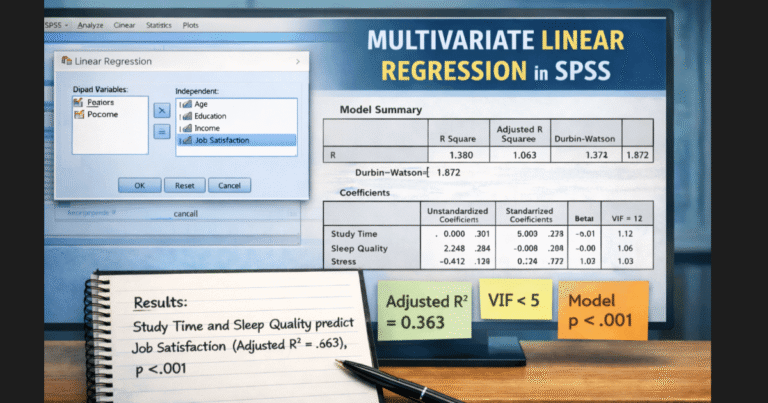
SPSS will generate output including the Model Summary, ANOVA table, and Coefficients table. These tables show statistical significance, model strength, and the contribution of each predictor.
When Your Regression Model Is Not Significant
A non-significant model does not always mean your research failed. It often indicates:
- Weak predictor variables
- Poor measurement design
- Small sample size
- Incorrect model selection
In some cases, regression may not even be the correct test. For example, if your study involves multiple dependent variables, you may need to consider approaches explained in MANOVA vs ANOVA.
Real Problem: Most Students Struggle With Interpretation
Running regression in SPSS is straightforward. Interpreting it correctly is where most students fail.
Common mistakes include:
- Confusing B and Beta coefficients
- Reporting p-values without context
- Ignoring effect sizes
- Drawing causal conclusions from correlational data
If your results feel unclear or inconsistent, the issue is often interpretation rather than calculation.
How to Fix a Regression That Does Not Make Sense
If your results do not align with expectations, take a structured approach:
First, go back to your dataset and confirm all variables are coded correctly. Then check for missing values and outliers. After that, test assumptions before interpreting results.
If everything appears correct but results still do not make sense, the issue may lie in your research design or variable selection. This is especially common in applied fields such as marketing or psychology, where variables may not strongly predict outcomes. In such cases, targeted support like consumer behavior data analysis help can help refine the model and interpretation.
When You Should Stop Struggling and Get Help
There is a point where continuing to troubleshoot alone wastes time. If you have:
- Re-run the model multiple times
- Checked assumptions but still feel unsure
- Received unclear feedback from your supervisor
then the issue is no longer technical, it is structural.
At this stage, working with someone experienced in dissertation data analysis services can help you resolve the problem quickly and move forward with confidence.
FAQs
Why is my multiple regression not significant in SPSS?
Your predictors may not strongly explain the dependent variable, or your sample size may be too small.
What causes wrong regression results in SPSS?
Common causes include poor data entry, missing values, incorrect coding, and assumption violations.
How do I know if my regression model is valid?
You need to test assumptions such as normality, homoscedasticity, and multicollinearity.
Why did my supervisor reject my regression analysis?
Most rejections happen due to poor interpretation, missing assumption checks, or weak justification of the model.
Can bad data affect regression results?
Yes. Poor data structure or errors during SPSS data entry can completely distort results.
What should I check before running regression in SPSS?
Ensure your data is clean, variables are coded correctly, and assumptions are understood.
Why are my coefficients inconsistent?
This may be due to multicollinearity or incorrect variable scaling.
What is multicollinearity in regression?
It occurs when independent variables are highly correlated, affecting coefficient stability.
Can I use regression for categorical outcomes?
No. You should use logistic regression instead.
Why is my R² value too low?
Your predictors may not strongly explain the outcome, or your model may be poorly specified.
How do I fix SPSS output errors?
Check dataset structure and review issues related to SPSS output not showing.
What if my supervisor is not helping with analysis?
This is common. Many students seek structured support when facing issues like those described in dissertation supervisor not helping.
When should I use MANOVA instead of regression?
When you have multiple dependent variables, as explained in MANOVA vs ANOVA.
Is regression enough for dissertation analysis?
Not always. Some studies require multiple methods depending on the research design.
How do I interpret regression results correctly?
Focus on coefficients, significance levels, and overall model fit, not just p-values.
What if my dataset has errors?
You need to clean it properly using structured methods like data cleaning in SPSS.