You are not behind because you are incapable. You are behind because you are carrying too much at once. A full-time job, academic pressure, and a complex dissertation create a workload that demands structure, not just motivation. When dissertation data analysis becomes the bottleneck, everything else stalls. Deadlines start closing in, confidence drops, and even simple tasks feel overwhelming.
This guide breaks that cycle. It shows you how to complete your dissertation data analysis while working full-time, without burnout and without sacrificing quality. It also shows you when it makes sense to bring in expert support so you can move forward instead of staying stuck.
Why Dissertation Data Analysis Becomes the Breaking Point
Most students do not fail at data collection or literature review. They stall at data analysis.
Here is why:
- You are expected to clean, code, and analyze data correctly
- You must choose the right statistical tests
- You need to interpret outputs in line with your research questions
- You must present results in a way your supervisor accepts
If you are using SPSS, R, Jamovi or another tool, even small errors can invalidate your results. That pressure builds quickly, especially when time is limited.
If you have ever stared at your dataset wondering where to begin, you are in the exact position many dissertation students face.
You can get a clearer breakdown of how analysis should flow in this guide on survey data analysis.
The Reality of Working Full-Time While Doing Analysis
Let’s address what most guides ignore.
You do not have unlimited time.
A typical week might look like:
- 30 to 40 hours of work
- Commute and personal responsibilities
- Limited mental energy after work
This means you cannot rely on long, unfocused study sessions. You need precision.
Instead of trying to “catch up,” you need to restructure your approach.
Step 1: Define Exactly What Needs to Be Done
Before opening SPSS or R, you must map your analysis.
Break your work into specific components:
- Data cleaning
- Descriptive statistics
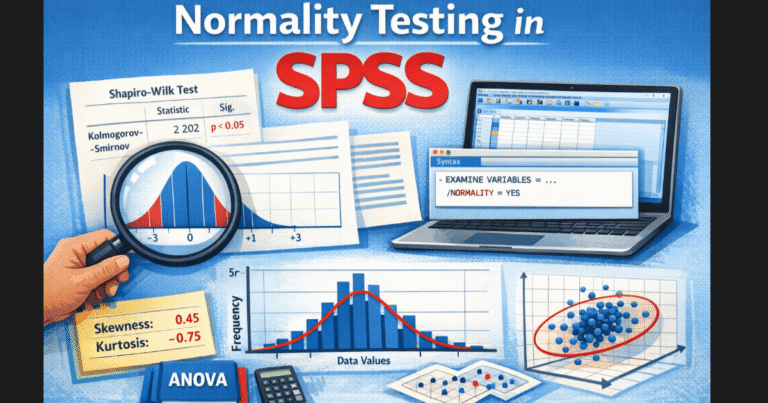
- Assumption testing
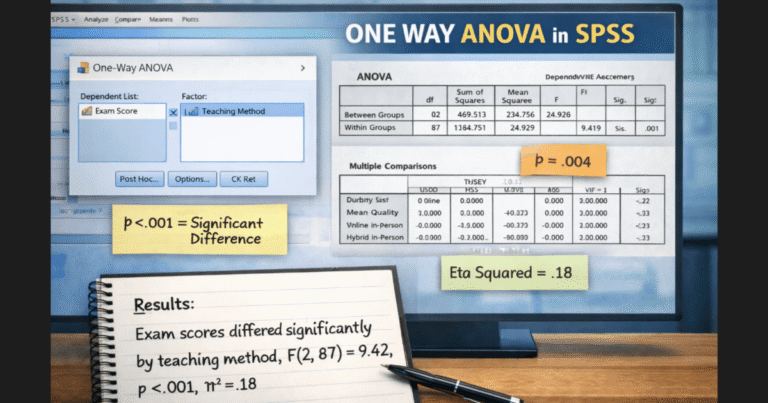
- Main analysis (regression, ANOVA, correlation)
- Interpretation and write-up
If you skip this step, you will waste time switching between tasks.
If you are unsure how to structure your Chapter 4, this resource on how to write up a dissertation analysis using SPSS gives a clear framework.
Step 2: Match Your Research Questions to the Right Tests
One of the biggest delays comes from choosing the wrong statistical method.
For example:
- Comparing two groups → t-test
- Comparing multiple groups → ANOVA
- Testing relationships → correlation or regression
If you are unsure, do not guess.
Use targeted guides such as:
Each wrong test costs time because you will need to redo analysis later.
Step 3: Work in Focused Time Blocks
You cannot rely on long study sessions after work. Instead:
- Use 60 to 90 minute focused blocks
- Assign one task per session
- Stop when the task is complete
Example:
Monday evening: Clean dataset
Tuesday evening: Run descriptive analysis
Wednesday evening: Test assumptions
This approach builds progress even with limited time.
Step 4: Eliminate Data Issues Early
Messy data slows everything down.
You must:
- Check missing values
- Recode variables correctly
- Label variables clearly
If this step is skipped, your outputs will not make sense.
This guide on data cleaning in SPSS helps you fix common issues early.
Step 5: Focus on Interpretation, Not Just Output
Running tests is not enough.
You must explain:
- What the results mean
- Whether they support your hypotheses
- How they connect to your research objectives
Many students struggle here.
For example, a significant p-value does not explain your findings by itself. You must interpret it correctly. This guide on p-value less than 0.05 explains how to do that properly.
Step 6: Manage the Psychological Barrier
The post you shared highlights something critical:
The voice that says you are not good enough.
That voice grows when:
- You delay work
- You do not understand the analysis
- You compare yourself to others
You do not remove that pressure by pushing harder. You remove it by creating clarity.
When you know exactly what to do next, the anxiety reduces.
Step 7: Know When to Get Expert Help
There is a point where doing everything yourself becomes inefficient.
If you are:
- Running out of time
- Unsure about your analysis approach
- Getting inconsistent results
- Struggling with Chapter 4
Then expert support can save your dissertation.
You can explore structured support through dissertation data analysis services, where your dataset is handled correctly and results are prepared for submission.
If your issue is more tool-specific, this page on SPSS dissertation help can guide you.
This is not about avoiding work. It is about ensuring accuracy and finishing on time.
Step 8: Combine Strategy with Execution
Here is what a practical weekly plan looks like:
First week
- Clean and structure data.
- Define variables.
Second week
- Run descriptive statistics.
- Check assumptions.
Third week
- Run main analysis
Fourth week
- Interpret results and write Chapter 4
This structured approach prevents last-minute panic.
What Happens If You Do Nothing
If you continue without structure:
- You will keep switching between tasks
- You will doubt your results
- You will lose time correcting mistakes
Most importantly, you risk missing your deadline.
Conclusion
Finishing dissertation data analysis while working full-time requires strategy, not just effort.
You need:
- Clear task breakdown
- Correct statistical methods
- Focused work sessions
- Clean data
- Accurate interpretation
Once those pieces are in place, progress becomes predictable.
If you still feel stuck, do not wait until the deadline forces you into rushed work. Getting the right support early can protect both your results and your final grade.
FAQs on Dissertation Data Analysis
How can I finish dissertation data analysis quickly?
Break the work into clear stages, focus on one task at a time, and avoid switching between unrelated steps.
What is the biggest challenge in dissertation data analysis?
Choosing the correct statistical test and interpreting results correctly.
Can I complete data analysis while working full-time?
Yes, but only with structured time blocks and a clear plan.
How many hours per week should I dedicate?
At least 8 to 12 focused hours depending on your deadline.
What software should I use?
SPSS, R, or similar tools depending on your research design.
What if my SPSS output does not make sense?
Check your data coding and assumptions first. You can also review common issues here: SPSS output not showing.
How do I know which statistical test to use?
Match your research questions to test types. Do not rely on guesswork.
Can I outsource dissertation data analysis?
Yes, especially if time or technical knowledge is limited.
Is it risky to get help with analysis?
Not if the work is transparent, accurate, and aligned with your research.
How long does dissertation data analysis take?
Typically 2 to 4 weeks depending on complexity.
What should be included in Chapter 4?
Descriptive results, main analysis, and interpretation.
How do I analyze Likert scale data?
Use appropriate methods depending on whether you treat data as ordinal or interval. See Likert scale analysis help.
What if my supervisor is not helpful?
You can still progress by following structured guides like this one: dissertation supervisor not helping.
How do I avoid redoing analysis?
Plan your tests correctly before running them.
Where can I get full dissertation data analysis support?
You can explore complete support at SPSS Dissertation help