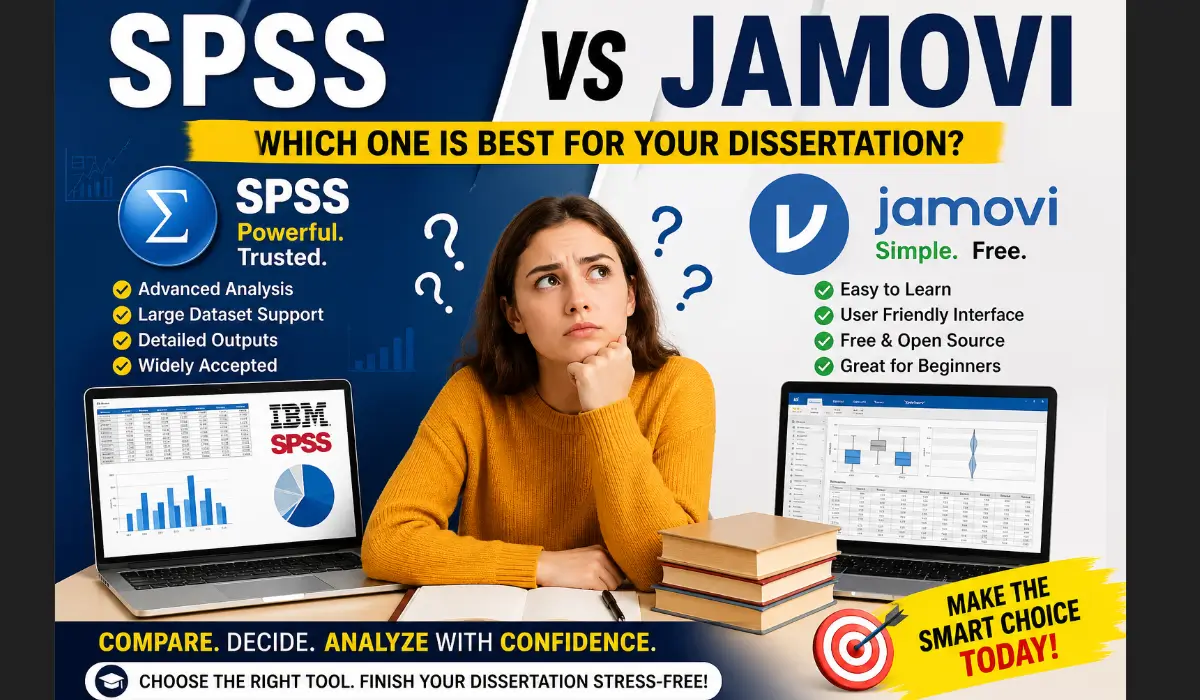
Dissertation students often reach a critical point where software choice starts to affect progress, confidence, and even submission timelines. If you are comparing SPSS vs Jamovi, you are likely asking one practical question: which tool will help you complete your analysis faster, cleaner, and with fewer revisions?
This guide gives you a clear, experience-based comparison. It focuses on real dissertation workflows, not generic feature lists. You will understand where each tool excels, where it slows you down, and which one aligns with your academic goals.
SPSS vs Jamovi Comparison: Core Differences That Matter
At a surface level, both tools perform statistical analysis. However, their underlying design philosophy differs completely.
SPSS focuses on structured, enterprise-level statistical workflows. It gives you full control over data manipulation, advanced modeling, and output customization.
Jamovi focuses on simplicity and accessibility. It builds on R but removes coding complexity, offering a clean interface for quick analysis.
Here is what matters for dissertation students:
- SPSS handles complex datasets and advanced modeling better
- Jamovi reduces learning time and simplifies execution
- SPSS produces outputs that align closely with academic expectations
- Jamovi offers faster setup but less flexibility in edge cases
If your dissertation involves multiple variables, hypothesis testing, and supervisor scrutiny, the differences start to show quickly.
Ease of Use: Jamovi Wins Early, SPSS Wins Long-Term
Jamovi feels intuitive from the first session. You can import data, run descriptive statistics, and generate outputs within minutes. This makes it attractive for students who feel overwhelmed.
However, that simplicity becomes a limitation when:
- You need custom transformations
- You work with complex regression models
- You must troubleshoot statistical assumptions
SPSS, on the other hand, requires more effort at the start. You need to understand variable views, data structures, and output interpretation. However, once you get comfortable, it becomes significantly more powerful.
If you feel stuck at the beginning, Jamovi helps. If you want full control and fewer limitations later, SPSS gives you that advantage.
For structured SPSS workflows, this guide on how to run a linear regression in SPSS shows how analysis actually progresses in a dissertation context.
Statistical Capability: SPSS Dominates Advanced Analysis
When comparing jamovi vs spss comparison at a deeper level, statistical depth becomes the deciding factor.
SPSS supports:
- Complex regression models
- Mixed ANOVA and MANOVA
- Advanced data transformations
- Missing data handling
- Extensive assumption testing
Jamovi supports most standard tests:
- T-tests
- ANOVA
- Correlation
- Basic regression
However, once your dissertation moves into advanced modeling, Jamovi often requires additional modules or workarounds.
For example, if you plan to run multivariate models, you will rely heavily on tools like multivariate linear regression in SPSS.
If your research stays basic, Jamovi works. If your supervisor expects depth, SPSS becomes necessary.
Output Quality and Dissertation Write-Up
Your analysis does not end with results. You must present those results in Chapter 4 clearly and professionally.
SPSS produces outputs that:
- Align closely with APA reporting
- Provide detailed tables and statistics
- Allow structured interpretation
Jamovi produces cleaner visuals but sometimes lacks the depth required for formal academic reporting.
Many students struggle at this stage. They run the analysis but fail to interpret or present it correctly. That is why structured guidance like how to write up a dissertation analysis using SPSS becomes essential.
If your goal is submission-ready output, SPSS gives you fewer obstacles.
Cost Consideration: Jamovi Is Free, SPSS Is an Investment
Jamovi stands out because it is completely free. This makes it attractive for students working under budget constraints.
SPSS requires a license. However, many universities provide access. Even when you pay for it, the cost often reflects the level of capability you get.
If cost drives your decision alone, Jamovi wins.
If results quality and flexibility matter more, SPSS justifies the investment.
Learning Curve vs Dissertation Pressure
Time pressure changes everything.
If you have limited time:
- Jamovi helps you get started quickly
- You can run basic tests without deep training
If you have a complex dataset and strict supervisor expectations:
- SPSS reduces the risk of rework
- You avoid limitations that force you to restart analysis
Many students begin with Jamovi, then switch to SPSS when complexity increases. That transition often wastes time.
A better approach involves choosing the right tool from the start based on your research design.
For clarity on statistical methods and tool selection, reviewing statistical tools in research helps align your decision with your methodology.
When to Use SPSS for Your Dissertation
Choose SPSS if:
- Your dissertation involves multiple variables
- You need regression, ANOVA, or advanced tests
- Your supervisor expects detailed outputs
- You want fewer technical limitations
SPSS works best when accuracy, depth, and academic presentation matter.
If you are already working with survey data, combining SPSS with structured workflows from survey data analysis improves both speed and clarity.
When to Use Jamovi for Your Dissertation
Choose Jamovi if:
- Your analysis remains simple
- You need quick results for basic tests
- You want a free alternative
- You feel overwhelmed by SPSS
Jamovi works well for exploratory analysis and early-stage research.
However, if your dissertation evolves, you may outgrow it quickly.
Common Mistake Students Make in SPSS vs Jamovi Choice
Students often choose based on ease instead of outcome.
They ask:
- Which tool looks simpler?
- Which one loads faster?
Instead, you should ask:
- Which tool supports my research design fully?
- Which one prevents rework later?
This shift saves time and reduces frustration.
If your supervisor expects rigorous statistical analysis, choosing the wrong tool creates delays, corrections, and stress.
The Real Question: SPSS vs Jamovi for Dissertation Success
This comparison comes down to one thing: completion without setbacks.
- Jamovi helps you start
- SPSS helps you finish
If your dissertation requires depth, precision, and clean reporting, SPSS remains the stronger choice.
If your analysis stays simple and exploratory, Jamovi can work.
Need Help Choosing or Running Your Analysis?
Many dissertation students struggle not because of the software, but because of unclear analysis direction.
You may face:
- Confusion about which test to run
- Errors in SPSS output
- Difficulty interpreting results
- Revisions from your supervisor
If that sounds familiar, getting expert support can save weeks of trial and error.
You can explore professional guidance through dissertation data analysis services or get targeted help via online SPSS help depending on your stage.
Conclusion
The SPSS vs Jamovi decision affects more than software preference. It affects your workflow, accuracy, and final dissertation quality.
Jamovi offers speed and simplicity.
SPSS offers depth and reliability.
If your goal involves submitting strong, defensible results without repeated corrections, SPSS provides a more dependable path.
If you already feel stuck or uncertain, do not wait until deadlines force rushed decisions. Choose the tool that aligns with your research complexity and gives you control over your results.
FAQs: SPSS vs Jamovi for Dissertation Students
Is SPSS better than Jamovi for dissertation data analysis?
SPSS works better for dissertations that involve complex statistical tests, large datasets, and strict academic reporting. Jamovi handles basic analysis well, but SPSS gives you more control, especially when your supervisor expects detailed outputs. If you want a full breakdown of dissertation workflows, review dissertation data analysis.
Can I complete my entire dissertation using Jamovi?
Yes, but only if your analysis remains simple. Jamovi supports common tests like t-tests, ANOVA, and correlations. However, if your research involves advanced modeling or complex datasets, you will likely need SPSS or additional tools. A deeper overview of Jamovi workflows appears in jamovi data analysis.
Which is easier to learn: SPSS or Jamovi?
Jamovi is easier to learn at the beginning. It has a clean interface and fewer technical steps. SPSS takes longer to understand, but once you master it, you gain more flexibility and fewer limitations.
Do universities prefer SPSS over Jamovi?
Most universities and supervisors still prefer SPSS because it aligns closely with traditional statistical training and reporting standards. Jamovi gains popularity, but SPSS remains more widely accepted in dissertation submissions.
Is Jamovi reliable for academic research?
Yes, Jamovi is reliable for statistical analysis. It builds on R, which is widely trusted. However, its limitations appear when handling advanced techniques or customized outputs required in dissertations.
Can Jamovi replace SPSS completely?
Jamovi can replace SPSS for basic and intermediate analysis. It cannot fully replace SPSS for advanced statistical modeling, complex data handling, or highly customized outputs.
Which software produces better dissertation results tables?
SPSS produces more detailed and structured tables that match APA formatting expectations. Jamovi produces cleaner visuals, but sometimes lacks the depth required for academic write-ups.
Is SPSS harder to use than Jamovi?
SPSS requires more initial learning. You need to understand data structures, variable settings, and output interpretation. Jamovi simplifies this process, but that simplicity reduces flexibility later.
What statistical tests can Jamovi perform?
Jamovi supports:
- Descriptive statistics
- T-tests
- ANOVA
- Correlation
- Basic regression
For a complete overview of its capabilities, check jamovi statistics.
What statistical tests require SPSS instead of Jamovi?
You should use SPSS for:
- Multivariate regression
- Mixed ANOVA
- Logistic regression
- Advanced data transformations
- Missing data handling
These tests often exceed Jamovi’s built-in capabilities.
Is Jamovi really free to use?
Yes, Jamovi is completely free. You can install and use it without any license. This makes it attractive for students working with limited budgets.
Does SPSS justify its cost for dissertation students?
Yes, especially if your research involves complex analysis. The cost reflects the depth, flexibility, and reliability that SPSS provides during dissertation work.
Which software is better for beginners in statistics?
Jamovi works better for beginners because it removes technical complexity. However, beginners working on dissertations may still need SPSS later due to academic requirements.
Can I switch from Jamovi to SPSS midway through my dissertation?
Yes, but switching often causes delays. Data formatting, output differences, and reanalysis can slow your progress. Choosing the right tool early saves time.
Which software helps reduce dissertation revisions?
SPSS reduces revisions because it provides detailed outputs, supports advanced analysis, and aligns with supervisor expectations. Jamovi may require adjustments if results lack depth.
Is Jamovi good for survey data analysis?
Yes, Jamovi handles survey data well for basic analysis. However, if your survey involves complex relationships or advanced testing, SPSS provides better support. For structured guidance, see introduction to jamovi free.
What should I choose if I feel stuck with my dissertation analysis?
If you feel stuck, focus less on the software and more on getting the analysis right. Many students struggle with selecting tests, interpreting outputs, and writing results. In such cases, reviewing structured support like dissertation data analysis helps you move forward with clarity.