Choosing the right statistical tools for data analysis can be one of the most confusing parts of a dissertation, thesis, or research project.
You may have already collected your data. Your questionnaire responses may be sitting in Excel, SPSS, or a CSV file. However, when it is time to analyse the results, difficult questions begin to appear.
Should you use a t-test or ANOVA? Is correlation enough, or do you need regression? What statistical tool is appropriate for Likert scale data? Should you analyse the data in SPSS, R, Stata, or Jamovi?
For many students, choosing the wrong statistical tool can affect the entire results chapter. The analysis may fail to answer the research questions, statistical assumptions may be ignored, and the final interpretation may not match the study objectives.
This guide explains the most common statistical tools for data analysis, their examples, and how to choose an appropriate method for quantitative research.
If you already have a dataset but are unsure which statistical test to run, professional dissertation data analysis services can help with test selection, data cleaning, analysis, interpretation, and results reporting.
What Are Statistical Tools for Data Analysis?
Statistical tools for data analysis are methods, techniques, and software used to organise, summarise, compare, and interpret research data.
In simple terms, statistical tools help researchers turn raw numbers into meaningful findings.
For example, imagine that a student collects questionnaire responses from 300 university students. Looking at 300 rows of raw data will not immediately answer the research questions.
Statistical tools can help the student:
- Calculate the average age of respondents.
- Summarise gender or programme distributions.
- Measure the reliability of questionnaire items.
- Determine whether two groups have different mean scores.
- Examine relationships between variables.
- Predict an outcome using one or more independent variables.
- Test research hypotheses.
The appropriate statistical tool depends on the research question, study design, type of variables, number of groups, and statistical assumptions. Guidance on statistical test selection also emphasises that the hypothesis, data type, and number or structure of measurements influence the choice of analysis.
This is why selecting a test simply because it appears in another dissertation can lead to incorrect analysis.
Quick List of Statistical Tools for Data Analysis
The most common statistical tools used in student research include:
| Statistical tool | Main purpose | Example research use |
|---|---|---|
| Frequencies | Count observations | Number of male and female respondents |
| Percentages | Show proportions | Percentage of satisfied participants |
| Mean | Calculate average | Average satisfaction score |
| Median | Find middle value | Median household income |
| Standard deviation | Measure spread | Variation in examination scores |
| Cronbach’s alpha | Assess reliability | Reliability of a Likert scale |
| Pearson correlation | Test linear relationships | Relationship between age and income |
| Spearman correlation | Test ordinal or monotonic relationships | Relationship between rankings |
| Independent t-test | Compare two independent groups | Male versus female mean scores |
| Paired t-test | Compare two related measurements | Pre-test versus post-test scores |
| ANOVA | Compare three or more means | Satisfaction across three departments |
| Chi-square test | Test association between categorical variables | Gender and product preference |
| Linear regression | Predict a continuous outcome | Predicting academic performance |
| Logistic regression | Predict a categorical outcome | Predicting yes/no outcomes |
| Mann-Whitney U test | Compare two independent groups nonparametrically | Comparing ordinal scores |
| Kruskal-Wallis test | Compare three or more groups nonparametrically | Comparing rankings across departments |
| Factor analysis | Identify underlying constructs | Validating questionnaire dimensions |
The important question is not how many statistical techniques you know. The real challenge is determining which tool correctly answers your specific research question.
Students who are uncertain about their analysis plan can get dissertation statistics help before running inappropriate tests or rewriting an entire results chapter.
Types of Statistical Tools Used in Research
Statistical tools in research are commonly divided into descriptive statistics and inferential statistics.
Understanding this distinction makes test selection much easier.
1. Descriptive Statistical Tools
Descriptive statistical tools summarise the characteristics of a dataset.
They describe what the collected data looks like without making broader conclusions about a population.
Frequencies
A frequency shows how many times a category or response appears in the dataset.
For example:
- 120 undergraduate students
- 80 postgraduate students
- 65 respondents selected “Satisfied”
- 25 respondents selected “Dissatisfied”
Frequencies are commonly used for demographic variables and categorical questionnaire responses.
Percentages
Percentages express frequencies as proportions of the total sample.
For example, if 180 out of 300 respondents reported being satisfied, the researcher may report that 60% of participants were satisfied.
Percentages are particularly useful when presenting survey results.
Students working with questionnaire responses may also need questionnaire data analysis help to correctly code, clean, analyse, and interpret survey datasets.
Mean
The mean is the arithmetic average of a set of numerical values.
It is frequently used to summarise variables such as:
- Age
- Income
- Examination scores
- Scale scores
- Test results
However, using the mean automatically for every variable is a common statistical mistake. The level of measurement and distribution of the data should be considered.
Median
The median is the middle value after observations are arranged from lowest to highest.
It can be more appropriate than the mean when data are strongly skewed or affected by extreme values.
Income is a common example because a small number of extremely high values can substantially increase the mean.
Mode
The mode is the most frequently occurring value or category.
It may be useful for categorical variables such as the most commonly selected response, preferred product, or frequently reported category.
Standard Deviation
Standard deviation measures how spread out numerical values are around the mean.
A smaller standard deviation indicates that values are relatively close to the mean. A larger standard deviation suggests greater variation.
For students using SPSS, a detailed descriptive analysis in SPSS guide explains how common summary statistics are produced.
2. Inferential Statistical Tools
Inferential statistics help researchers use sample data to test hypotheses, examine relationships, compare groups, and draw conclusions.
These are often the statistical tools students find most difficult because the correct test depends on several features of the study.
T-Tests for Comparing Two Means
A t-test is commonly used when a researcher wants to compare mean scores.
However, there are different types of t-tests.
Independent Samples T-Test
An independent samples t-test compares the means of two separate groups.
Example research question:
Is there a significant difference in academic performance between students who attend online classes and students who attend face-to-face classes?
The groups are independent because each participant belongs to only one group.
Students using SPSS can follow the independent samples t-test in SPSS guide.
Paired Samples T-Test
A paired samples t-test compares two related measurements.
For example:
Is there a significant difference between participants’ pre-intervention and post-intervention scores?
The same participants are measured twice.
The paired sample t-test in SPSS guide provides additional guidance on running and interpreting this analysis.
One of the most common student errors is using an independent t-test for paired data or a paired t-test for independent groups.
ANOVA for Comparing Three or More Groups
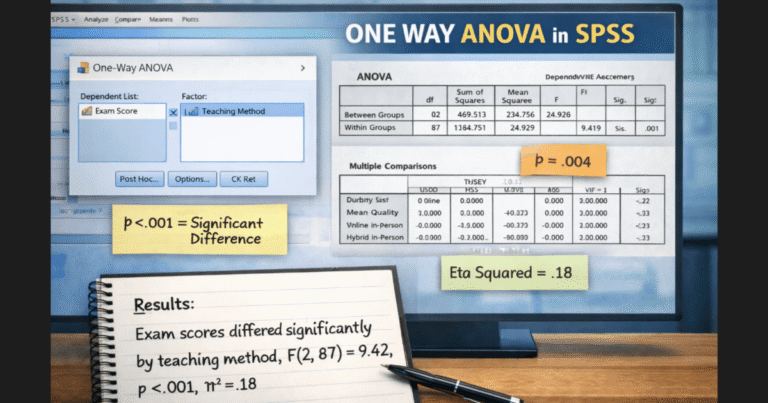
Analysis of Variance, commonly called ANOVA, is used to compare means across groups.
A one-way ANOVA may be appropriate when there is:
- One categorical independent variable.
- Three or more independent groups.
- One continuous dependent variable.
For example:
Is there a significant difference in job satisfaction among employees in the HR, finance, and marketing departments?
Running several separate t-tests is generally not an appropriate replacement for ANOVA because repeated testing can increase the risk of Type I error.
Students who are unsure about the distinction can review ANOVA vs t-test or the practical one-way ANOVA in SPSS guide.
More complex research designs may require factorial ANOVA, repeated measures ANOVA, mixed ANOVA, MANOVA, or ANCOVA.
Correlation for Testing Relationships
Correlation analysis examines the relationship between variables.
Two commonly used statistical tools are Pearson correlation and Spearman correlation.
Pearson Correlation
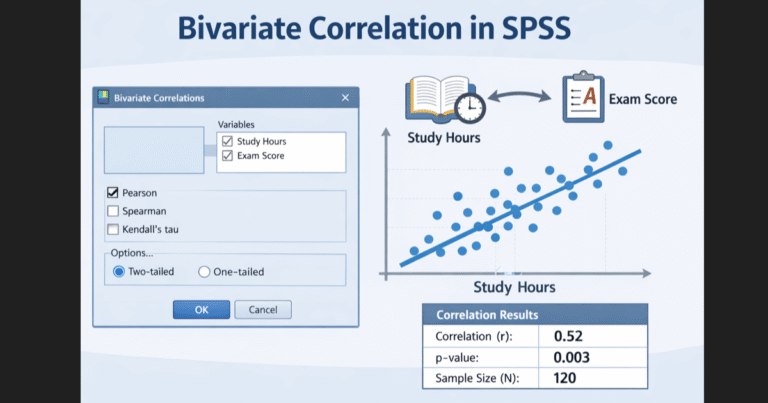
Pearson correlation is commonly used to examine a linear relationship between continuous variables when relevant assumptions are satisfied.
Example:
Is there a relationship between study hours and examination scores?
The correlation coefficient indicates the direction and strength of the relationship.
Students can see a practical example in the Pearson correlation in SPSS guide.
Spearman Correlation
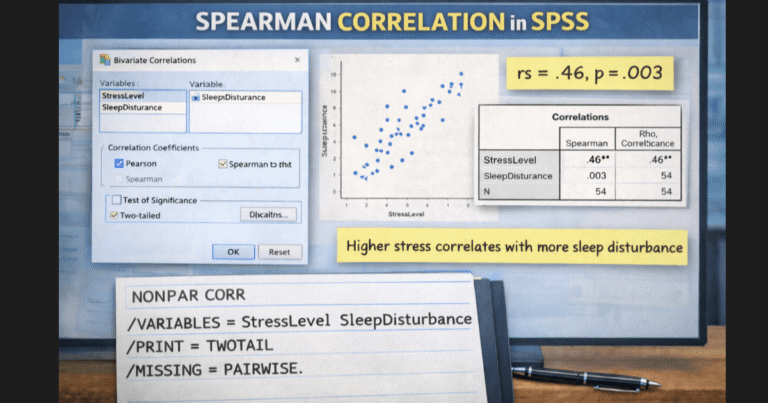
Spearman’s rank correlation is a nonparametric measure commonly considered for ordinal data or monotonic relationships when Pearson correlation is unsuitable.
The Spearman correlation SPSS guide explains its application and interpretation.
A significant correlation should not automatically be interpreted as evidence that one variable causes another. This is an important distinction when writing dissertation results and discussions.
Chi-Square Test for Categorical Data
The chi-square test of independence examines whether two categorical variables are associated.
Example:
Is there a significant association between gender and preferred learning method?
Both variables are categorical.
A chi-square test may also be useful for variables such as:
- Employment status
- Treatment group
- Product preference
- Yes/no responses
- Education category
Students can review the chi-square test in SPSS guide for a practical explanation.
Expected cell frequencies and other requirements should be checked before interpreting the results.
Regression Analysis for Prediction and Explanation
Regression is one of the most important statistical tools for data analysis in dissertations, theses, business research, and health studies.
It examines how one or more predictor variables relate to an outcome.
Simple Linear Regression
Simple linear regression includes one predictor and one continuous dependent variable.
Example:
Does study time significantly predict examination performance?
Students analysing this type of research question can review the simple linear regression in SPSS guide.
Multiple Linear Regression
Multiple regression includes two or more predictors.
For example:
Do study hours, attendance, and academic motivation significantly predict examination performance?
Multiple regression allows the researcher to examine the contribution of predictors while considering other variables in the model.
For practical assistance, see multiple regression in SPSS.
Logistic Regression
Logistic regression is used when the outcome variable is categorical.
Binary logistic regression is appropriate for outcomes with two categories, such as:
- Yes or no
- Passed or failed
- Disease present or absent
- Purchased or did not purchase
The binary logistic regression SPSS guide explains how this analysis differs from linear regression.
Choosing between linear, binary logistic, multinomial logistic, and ordinal logistic regression depends heavily on the dependent variable.
Nonparametric Statistical Tools
Not every dataset meets the assumptions required for common parametric statistical tests.
Nonparametric statistical tools may be considered when the research design, measurement level, distribution, or assumptions make a parametric procedure unsuitable.
Common examples include:
- Mann-Whitney U test
- Wilcoxon signed-rank test
- Kruskal-Wallis test
- Spearman correlation
The Mann-Whitney U test can be used to compare two independent groups in appropriate nonparametric settings. The Mann-Whitney U test in SPSS guide explains the procedure.
For three or more groups, researchers may consider the Kruskal-Wallis test.
Students should not choose a nonparametric test simply because the sample is “small.” Test selection should be based on the complete research and data context.
Reliability Analysis Using Cronbach’s Alpha
Cronbach’s alpha is one of the most common statistical tools used in questionnaire-based research.
It assesses the internal consistency of a set of scale items.
For example, a student may use five Likert items to measure academic motivation. Reliability analysis can help assess whether the items consistently measure the intended construct.
However, simply reporting an alpha value without considering the scale structure, item coding, and questionnaire design can produce misleading conclusions.
The Cronbach’s alpha reliability in SPSS guide provides a detailed explanation of the procedure.
If the entire dataset comes from a questionnaire, professional survey data analysis help may be useful for coding, reliability testing, hypothesis testing, and interpretation.
Factor Analysis as a Statistical Tool
Factor analysis is commonly used to investigate underlying structures or constructs represented by multiple variables.
Exploratory factor analysis may help researchers identify groups of related items.
For example, a 25-item questionnaire may contain items measuring:
- Academic motivation
- Learning satisfaction
- Instructor support
- Student engagement
Factor analysis can help examine whether the observed questionnaire items group into expected dimensions.
Students can learn more from the exploratory factor analysis in SPSS guide.
Confirmatory factor analysis is different because it tests a theoretically specified measurement structure.
Statistical Analysis Tools and Software for Students
The term “statistical tools” can also refer to software used to perform data analysis.
Common statistical analysis tools for students include SPSS, R, Stata, Jamovi, and Excel.
SPSS
IBM SPSS Statistics provides tools for statistical analysis, predictive modelling, regression, data preparation, and other analytical procedures.
SPSS is frequently used by students in:
- Social sciences
- Psychology
- Education
- Nursing
- Business
- Public health
- Marketing
Its menu-based interface can make many common procedures accessible, but selecting and interpreting the correct analysis still requires statistical knowledge.
Students struggling with their datasets can get online SPSS help for data analysis, interpretation, and results reporting.
R
The R Project for Statistical Computing describes R as a free software environment for statistical computing and graphics that runs on major operating systems.
R is particularly useful for:
- Statistical modelling
- Data visualisation
- Reproducible analysis
- Advanced statistical methods
- Custom analytical workflows
The learning curve can be difficult for students with limited programming experience. Students who need assistance can use statistical analysis in R help.
Stata
Stata is widely used for statistical analysis in disciplines such as economics, epidemiology, public health, and social research.
It supports data management, regression modelling, panel data analysis, and other statistical procedures.
Students facing coursework or research difficulties can access Stata assignment help.
Jamovi
Jamovi provides a graphical interface for statistical analysis and is often attractive to students who want a menu-driven environment.
It can be used for descriptive statistics, t-tests, ANOVA, regression, correlation, and other analyses.
The Jamovi data analysis service supports students who need help selecting, running, and interpreting statistical procedures in Jamovi.
Excel
Excel is useful for data organisation, cleaning, basic summaries, tables, and some statistical calculations.
However, complex dissertation analysis may require specialised statistical software, particularly when the research involves advanced modelling or detailed diagnostic testing.
How Do I Choose the Right Statistical Tool for My Research?
Choosing the correct statistical analysis should begin with the research question rather than the software menu.
A practical selection process is:
- Identify the research question or hypothesis. Are you describing data, comparing groups, examining an association, or predicting an outcome?
- Identify the dependent variable. Determine whether the outcome is continuous, ordinal, nominal, or binary.
- Identify the independent variable or predictors. Consider their measurement levels and number of categories.
- Determine whether groups are independent or related. The same participants measured twice require a different analytical approach from two separate groups.
- Check the number of groups or measurements. Comparing two groups may require a different test from comparing three or more groups.
- Evaluate statistical assumptions. Depending on the method, assumptions may involve normality, independence, linearity, homogeneity of variance, multicollinearity, or other model-specific conditions.
- Select software capable of running the analysis. SPSS, R, Stata, or Jamovi may all be appropriate depending on the project.
- Plan how the results will be interpreted and reported. A statistically significant p-value alone is rarely a complete results section.
General statistical test selection guidance from UCLA also stresses that test-choice tables are guidelines rather than absolute rules because some datasets can legitimately be analysed in different ways depending on the research objective and analytical approach.
Which Statistical Tool Should I Use? Simple Examples
Consider these common student research questions:
“What percentage of students are satisfied with online learning?”
Use frequencies and percentages.
“Is there a difference in mean satisfaction between male and female students?”
An independent samples t-test may be considered if the research design and assumptions support it.
“Did participants’ scores change after an intervention?”
A paired samples t-test may be appropriate for related pre-test and post-test measurements.
“Is there a difference in satisfaction among students from four faculties?”
A one-way ANOVA may be considered.
“Is gender associated with preferred learning method?”
A chi-square test of independence may be appropriate.
“Is academic motivation related to examination performance?”
Correlation may be considered if the objective is to examine the relationship.
“Does academic motivation predict examination performance?”
Regression may be more suitable when the research objective is prediction or modelling.
“Can age, income, and education predict whether a customer purchases a product?”
A logistic regression model may be appropriate if the outcome has two categories.
These examples are useful starting points, but the final statistical tool should be selected after reviewing the actual variables, coding, research design, and assumptions.
Common Mistakes Students Make When Choosing Statistical Tools
One of the biggest mistakes is selecting a statistical test before clearly understanding the research question.
Other common problems include:
- Using a t-test to compare more than two groups.
- Running Pearson correlation on unsuitable variables without checking the data.
- Treating every Likert item as continuous without considering the analytical context.
- Using linear regression for a binary dependent variable.
- Ignoring missing data.
- Failing to check statistical assumptions.
- Running multiple tests without a clear analysis plan.
- Reporting only p-values.
- Confusing correlation with causation.
- Copying statistical methods from another dissertation.
- Selecting a test because SPSS makes it easy to click through the menu.
Another serious problem is running the correct statistical test but interpreting the output incorrectly.
A student may obtain SPSS tables containing coefficients, confidence intervals, significance values, R-squared statistics, odds ratios, or assumption tests but still be unable to explain what the findings mean.
Students facing this problem can get help with SPSS analysis rather than submitting unexplained output tables.
Need Help Choosing Statistical Tools for Your Data Analysis?
Having data does not automatically make the analysis straightforward.
You may know your research objectives but still be unsure whether to use correlation, regression, ANOVA, chi-square, or a nonparametric test. You may have already run SPSS and received dozens of output tables without knowing which results belong in Chapter 4.
MySPSSHelp.com provides statistical data analysis support for students working on dissertations, theses, research projects, and assignments.
Support can include:
- Reviewing research questions and hypotheses.
- Checking variable types and coding.
- Cleaning research data.
- Selecting appropriate statistical tools.
- Running analysis in SPSS, R, Stata, or Jamovi.
- Checking statistical assumptions.
- Interpreting statistical output.
- Creating appropriate tables.
- Explaining findings in clear academic language.
- Supporting dissertation results and analysis chapters.
Students working on a thesis can request thesis data analysis help, while dissertation students can access dissertation data analysis services.
If you have already collected your data and are stuck at the analysis stage, visit MySPSSHelp.com to discuss your research questions, dataset, and required statistical analysis.
Conclusion
The right statistical tools for data analysis depend on what a researcher wants to discover from the data.
Descriptive tools such as frequencies, percentages, means, medians, and standard deviations help summarise research data. Inferential statistical tools such as t-tests, ANOVA, correlation, chi-square, and regression help researchers compare groups, examine relationships, test hypotheses, and model outcomes.
Software such as SPSS, R, Stata, and Jamovi can perform these analyses, but software cannot automatically determine the best statistical approach for every dissertation or thesis.
The research question, variable types, study design, and statistical assumptions must guide the analysis.
If you are staring at your dataset and asking, “What statistical test should I use for my research?”, professional dissertation statistics help can help you move from raw data to correctly selected analyses and clearly interpreted findings.
Frequently Asked Questions
What are statistical tools for data analysis?
Statistical tools for data analysis are methods and software used to organise, summarise, compare, and interpret data. Examples include mean, standard deviation, t-tests, ANOVA, correlation, chi-square, regression, SPSS, R, Stata, and Jamovi.
What are examples of statistical tools used in research?
Common statistical tools used in research include frequencies, percentages, mean, median, standard deviation, Cronbach’s alpha, Pearson correlation, Spearman correlation, t-tests, ANOVA, chi-square tests, regression, and factor analysis.
What are the basic statistical tools in research and data analysis?
Basic statistical tools include frequencies, percentages, mean, median, mode, range, variance, and standard deviation. These are mainly used to describe and summarise research data.
What statistical tools are used in quantitative research?
Quantitative research may use descriptive statistics, t-tests, ANOVA, correlation, chi-square tests, linear regression, logistic regression, nonparametric tests, reliability analysis, and factor analysis. The correct method depends on the research question and data.
What statistical tool should I use for my dissertation?
The correct statistical tool depends on your research question, dependent variable, independent variables, number of groups, study design, and statistical assumptions. A dissertation comparing two means may use a t-test, while a study predicting a continuous outcome may require regression.
What statistical tool is used for questionnaire data analysis?
Questionnaire data may be analysed using frequencies, percentages, descriptive statistics, Cronbach’s alpha, correlation, t-tests, ANOVA, chi-square tests, or regression. The appropriate analysis depends on the questionnaire structure and research objectives.
Is SPSS a statistical tool for data analysis?
Yes. SPSS is statistical analysis software used for data preparation, descriptive analysis, hypothesis testing, regression, predictive modelling, and other statistical procedures.
What is the difference between statistical methods and statistical software?
Statistical methods are analytical techniques such as ANOVA, correlation, and regression. Statistical software such as SPSS, R, Stata, and Jamovi is used to perform those methods on research data.
Which statistical tool is best for students?
There is no single best statistical tool for every student. SPSS is commonly used for menu-based statistical analysis, while R supports programming-based statistical computing and graphics. Stata and Jamovi may also be appropriate depending on the course, research field, and required analysis.
Where can I get help choosing the correct statistical test?
Students who are unsure which test matches their research questions can get professional statistical and data analysis help. The research objectives, variables, dataset, and study design can be reviewed before the appropriate statistical analysis is selected.